
Bandhani Sarees: When to Wear & How to Style

There is nothing pretty Like a Bandhani Saree
The instant you preserve a bandhani saree as much as the mild, you recognize its appeal without delay. The tiny, complicated dot masses are created completely by hand, and there are heaps of them every now and then. Each one a small act of craft via an artisan in Rajasthan or Gujarat.
Bandhani (additionally spelled Bandhni) is one among India's oldest textile traditions. The word itself comes from the Sanskrit bandh, which means "to tie." The approach includes tying small sections of fabric with thread before dyeing, growing a resist-dye impact that produces the function dot patterns.
However, right here's what I really like about bandhani sarees past the craft: they may be joyful. Each coloration is vibrant. Every sample is festive. They make you experience like a party is both taking place or drawing close.
Explore our complete Bandhani saree collection at Odhni as you examine.
A Brief History of Bandhani
The Bandhani craft originated in the Kutch region of Gujarat and parts of Rajasthan. It's believed so far back over 5,000 years, fragments of bandhani-like patterned cloth have been determined in historic Indus Valley excavations.
The most renowned centres of bandhani production today are Jamnagar, Bhuj, and Jodhpur. Each has its own distinct fashion, shade possibilities, and pattern vocabulary.
Bandhani isn't just a technique; it's a living tradition passed down through generations of artisan families. Each dot is tied by hand, and no portions are ever precisely alike. fabric historian Dr Rta Kapur Chishti, author of Saris of India.
This background makes each bandhani saree really specific. You are not shopping for cloth; you're shopping for craft history.
Types of Bandhani Sarees
Now not all bandhani sarees is the same. Right here's what differentiates the fundamental types.
Rajasthani Bandhani Sarees
- Generally is available in silk or cotton
- Colourful excessive-assessment shades deep reds, blues, pinks on dark or brilliant backgrounds
- Patterns include the traditional "shikari" (hunting) motifs and floral designs
- Often comes with a contrasting border
Gujarati Bandhani (Gharchola)
- The gharchola is historically a red and gold silk bandhani deeply related to Gujarati bridal customs
- Different Gujarati bandhani uses silks and georgettes with tricky multi-coloration styles
- Frequently capabilities rectangular grid styles known as *Vohra Gaji*
Chunari Bandhani
- Simpler, regularly cotton-based, with broader shade fields
- Extra on hand price factor
- Popular for normal and informal festive wear
Bandhani on Different Base Fabrics
|
Basic Fabrics |
Occasion Suitability |
Price Range |
|
Pure Silk |
Bridal, very formal |
High |
|
Georgette |
Parties, Semi formal |
Mid |
|
Cotton Silk |
Festive, casual |
Mid to Low |
|
Pure Cotton |
Everyday casual |
Low |
|
Chiffon |
Evening parties |
Mid |
Whilst Putting on a Bandhani Saree
That is where most fashion guides fail you; they give you vague answers.
Weddings
Bandhani sarees are ideal for wedding functions, particularly the mehendi, sangeet, and haldi ceremonies. The colour and vibrancy fit the energy of those activities flawlessly.
For the main wedding ceremony, opt for a silk bandhani in deep, rich tones with a zari border. It achieves the right balance of traditional and festive.
What to keep away from: Very bright, Holi-esque hues for formal wedding ceremonies. Reserve the ones for the fun pre-wedding ceremony occasions.
Navratri
That is arguably bandhani's maximum herbal domesticity. Every Navratri day has a particular color, and bandhani comes in all of them. The relationship among Gujarati subculture, Navratri, and bandhani textiles is deep and complex.
Pair a bandhani chaniya choli or a bandhani saree with conventional silver earrings for the most true appearance.
Diwali & Festive occasions
Diwali is the bandhani season. The festive energy of the patterns and the luminous quality of silk bandhani underneath Diwali diyas is unmatched.
Teej & Various Festivals
For Teej, the conventional colouration is green, and bandhani in deep indigo with yellow or gold accents is impressive. Karva Chauth, Gangaur, and similar fairs are also ideal activities.
Casual Outings & Daylight Activities
For casual outings, lighter cotton or cotton-silk bandhani works fantastically. The prints are effortlessly stylish and require minimal accessorizing.

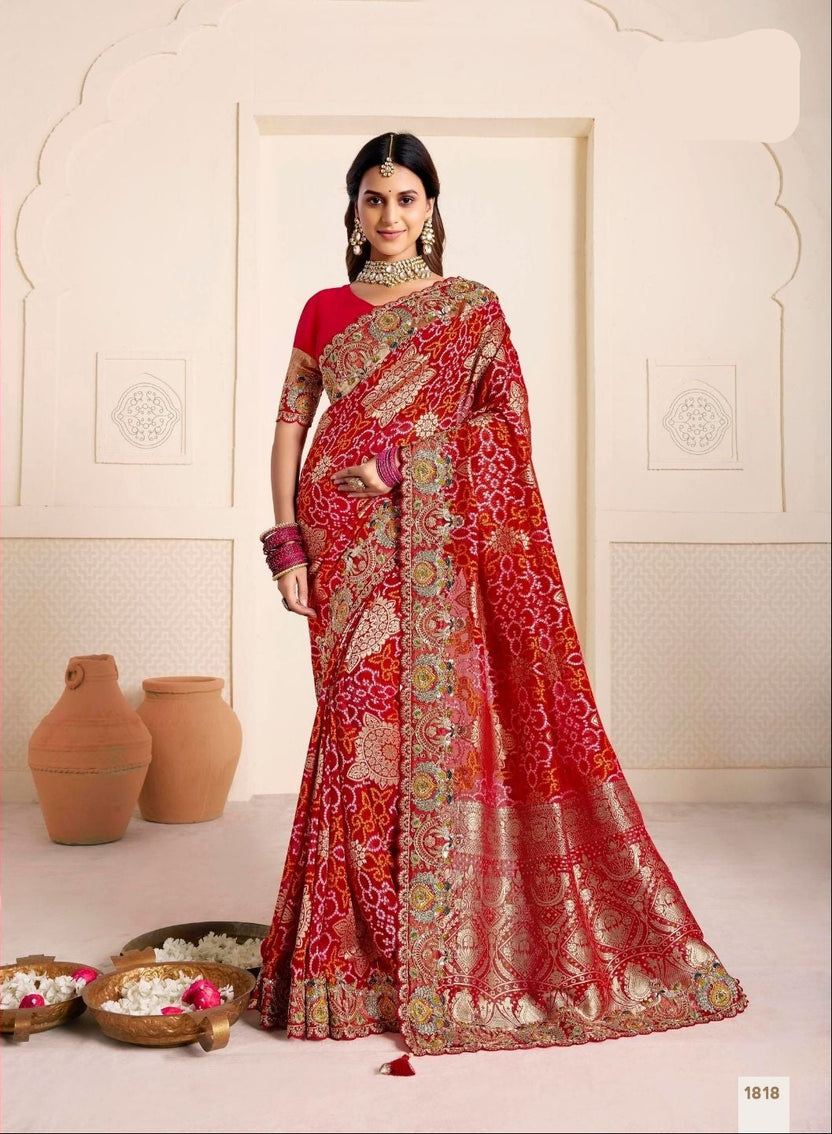
The way to fashion a Bandhani Saree
Styling bandhani properly is about letting the textile breathe. These sarees deliver their personal energy; your job is to supplement it, no longer compete with it.
Blouse alternatives
- Stable comparison blouses: The classic desire. Let the bandhani sample be the famous person; pair with a blouse in one of the dominant colorings of the saree
- Reflect paintings blouses: For festive occasions, a kutchi mirror-work blouse (from the identical craft location as bandhani) is a wonderfully matched pairing
- Backless blouses: modern and fashionable, works particularly nicely with lighter fabric like georgette or chiffon bandhani
- Puff-sleeved blouses: Very on-trend proper now. Provides a fashion-ahead touch to standard bandhani
Jewelry
Bandhani calls for classic Indian earrings, no longer minimalist western-fashion pieces.
- Silver rings: Oxidized silver is a specifically correct match with the craft aesthetic tribal-fashion jewelry, necklaces, or bangles
- Kundan and polki: For more formal activities
- Jadau jewelry: The conventional Rajasthani in shape for bandhani
- Terracotta earrings: distinctly lovely with cotton bandhani
Footwear
- Mojri or jutti is the plain, ideal choice
- Kolhapuris for casual activities
- Block heels for a greater contemporary examine events
- Avoid overly informal shoes like chappals or shoes for something formal
Dupatta Styling
If your bandhani is a saree, you already have a pallu. However, if you're carrying bandhani fabric as a dupatta with a kurti or sharara:
- Let it waft freely over one shoulder
- Pin it to suit the drape of your outfit
- Avoid heavy dupatta draping that obscures the print
Care Guidelines for Bandhani Sarees
Bandhani Sarees is delicate. In particular the hand-tied silk types.
- First wash: always dry a brand new bandhani saree for the primary wash. Colours can bleed.
- Second wash: mild hand wash in bloodless water with salt (fixes colourings). Never system wash.
- Drying: Dry in colour, not direct daylight; colours will fade faster in harsh sun.
- Storage: Fold along the unique fold lines, shop in tender muslin fabric.
- Ironing: Use low heat, usually on the reverse side.
Frequently Asked Questions
How can I tell if a bandhani saree is authentic?
True bandhani will have barely raised, bumpy dots at the opposite facet; those are the tied sections. The grain of the material seems nearly textured. Machine-printed "bandhani" can be flat and uniform on both sides.
Are bandhani sarees appropriate for office wear?
For work settings, you can go for cotton or cotton-silk bandhani in muted tones. Good options are navy, teal and earthy pink. Pair with a dependent blouse and keep jewellery minimal.
What's the distinction between bandhani and leheria?
Each is a tie-dye tradition from Rajasthan. Bandhani capabilities dot patterns created via tying tiny cloth factors. Leheria creates diagonal stripe patterns by rolling and tying the fabric along its length. Each is equally lovely but visually quite distinctive.
Can I put on a bandhani for a proper Hindu wedding ceremony?
Sure, select a silk bandhani with a zari border in deep, rich colourations like maroon, deep crimson, or military. Pair with conventional gold earrings. Avoid very vibrant chunari-style bandhani for formal ceremonies.
Do bandhani sarees require special draping strategies?
No. Bandhani sarees are draped within the widespread Nivi style. However, because many have one-of-a-kind pallus, consider how you show the pallus and allow the sample to show prominently.